Why there is no e-invoicing in Iraq, and what a shop should do instead
Taxes on a shop's sales in Iraq as of September 2026: no VAT, a selective sales tax, no e-invoicing, and what a cashier system should give you when the rules change.
The Dashing team4 min read
Almost every Arabic accounting program announces "e-invoicing compliant" for Saudi Arabia, Egypt or Jordan. A shop owner in Baghdad reads that and asks: and me? The short answer: there is no e-invoicing in Iraq today, no VAT, and no mandatory QR code on the invoice. The long answer is worth five minutes, because what you actually need today is not "compliance" but readiness.
What "e-invoicing" actually is
In the countries that apply it, it means every invoice is sent, instantly or periodically, to the tax authority's platform, and receives a number, stamp or QR code proving it was registered. Saudi Arabia started in 2021 (ZATCA's "Fatoora" platform), Egypt in phases since 2020, Jordan in 2022. The purpose is the same everywhere: a value-added tax collected at every stage of sale, which needs an invoice that cannot be forged.
Why Iraq has none
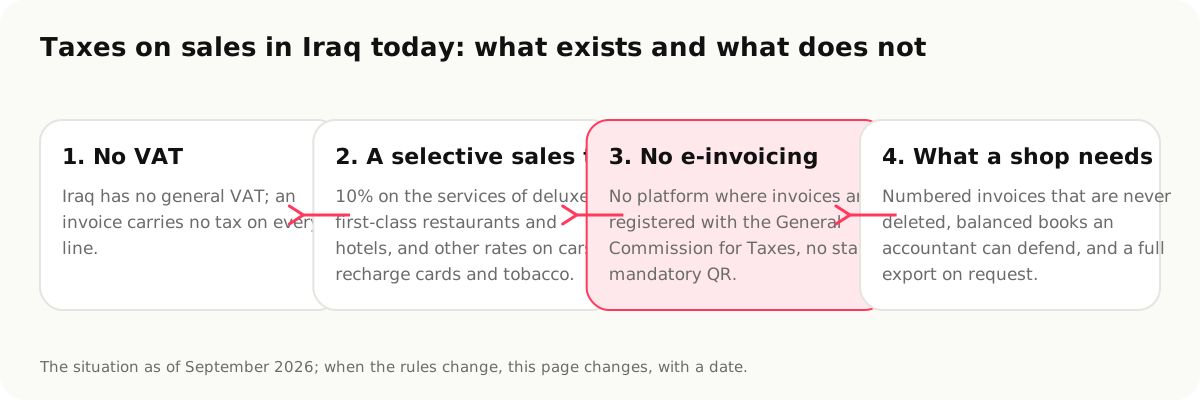
Because the foundation it is built on does not exist: Iraq has no VAT. What exists is a selective sales tax on specific goods and services, 10% on the services of deluxe and first-class restaurants and hotels, rates on cars, travel tickets, recharge cards and internet, and very high rates on tobacco and alcohol, collected and remitted by the business concerned. A grocery, clothing or mobile shop collects no sales tax on its invoice.
Income tax on business profits is assessed and paid yearly through the General Commission for Taxes, under assessment rules for professions and trades, not through live invoice registration. The Commission is digitising its procedures, but as of this article no published rule obliges shops to use an e-invoicing platform.
What this means for you today
- Do not pay for "compliance": any e-invoicing feature in an Arabic program is built for another tax authority and will not work for Iraq on the strength of a future announcement; a new implementation will be needed anyway.
- Do not print "tax" on the invoice if you are not obliged to collect it: it confuses the customer and your accountant.
- A good invoice is one you can defend: a sequential number that is never deleted, a date, lines, a tender, and the name of who issued it.
What a cashier system should give you so you are not caught out
When the rules change, and one day they will, you will be asked for what is asked everywhere: a complete, consistent record. Ask your system for this today:
- Sequentially numbered invoices that are never deleted: cancellation is a visible reversing entry, not an erasure. In Dashing (داشنك) no invoice is deleted; it is voided with a reversing entry and stays in the log under the name of whoever voided it.
- Balanced double-entry books: an income statement, balance sheet and trial balance from the same data the cashier enters, and a period close that stops a closed month from being edited.
- An audit log that cannot be edited: who did what and when.
- A full export in an open format (CSV) of any list at any time, so you can give the accountant or the authority what they ask for, in the shape they ask for it.
- A tax that can be turned on without being imposed: Dashing carries a tax engine that can be enabled for an item or for the shop when it is needed (a first-class restaurant, say) and stays off for a shop that collects none.
What Dashing does not do: and we will say so when it changes
It does not send invoices to any authority, does not generate a tax QR code, and does not file returns. If an e-invoicing platform is announced in Iraq, we will write about it here with the date, and build the connection after the specification is published, not before.
Sources
- PwC Worldwide Tax Summaries, Iraq: corporate other taxes (sales tax: 10% on deluxe and first-class restaurants and hotels, 15% on cars and travel tickets, 20% on recharge cards and internet, 300% on alcohol and tobacco; no VAT), https://taxsummaries.pwc.com/iraq/corporate/other-taxes (last reviewed 24 June 2026, accessed 2026-09-14)
- General Commission for Taxes, Iraqi Ministry of Finance, https://tax.mof.gov.iq/ (accessed 2026-09-14)
- e-invoicing.org, recently updated e-invoicing mandates (Iraq not listed with a mandate), https://e-invoicing.org/updates/ (2026-09-14)
- ZATCA, e-invoicing in Saudi Arabia, https://zatca.gov.sa/en/E-Invoicing/Pages/default.aspx
This article is also available in العربية