A cashier for grocery shops and supermarkets: the carton and the piece, weight, and an expiry date per batch.
Dashing for grocery is the cashier, stock and books for a shop where the evening queue cannot wait: the same item sold by the carton and by the piece, each with its own barcode; vegetables and cheese by typed weight; milk by its batch and expiry date. When the internet drops, sales are saved on the device and uploaded when it returns.
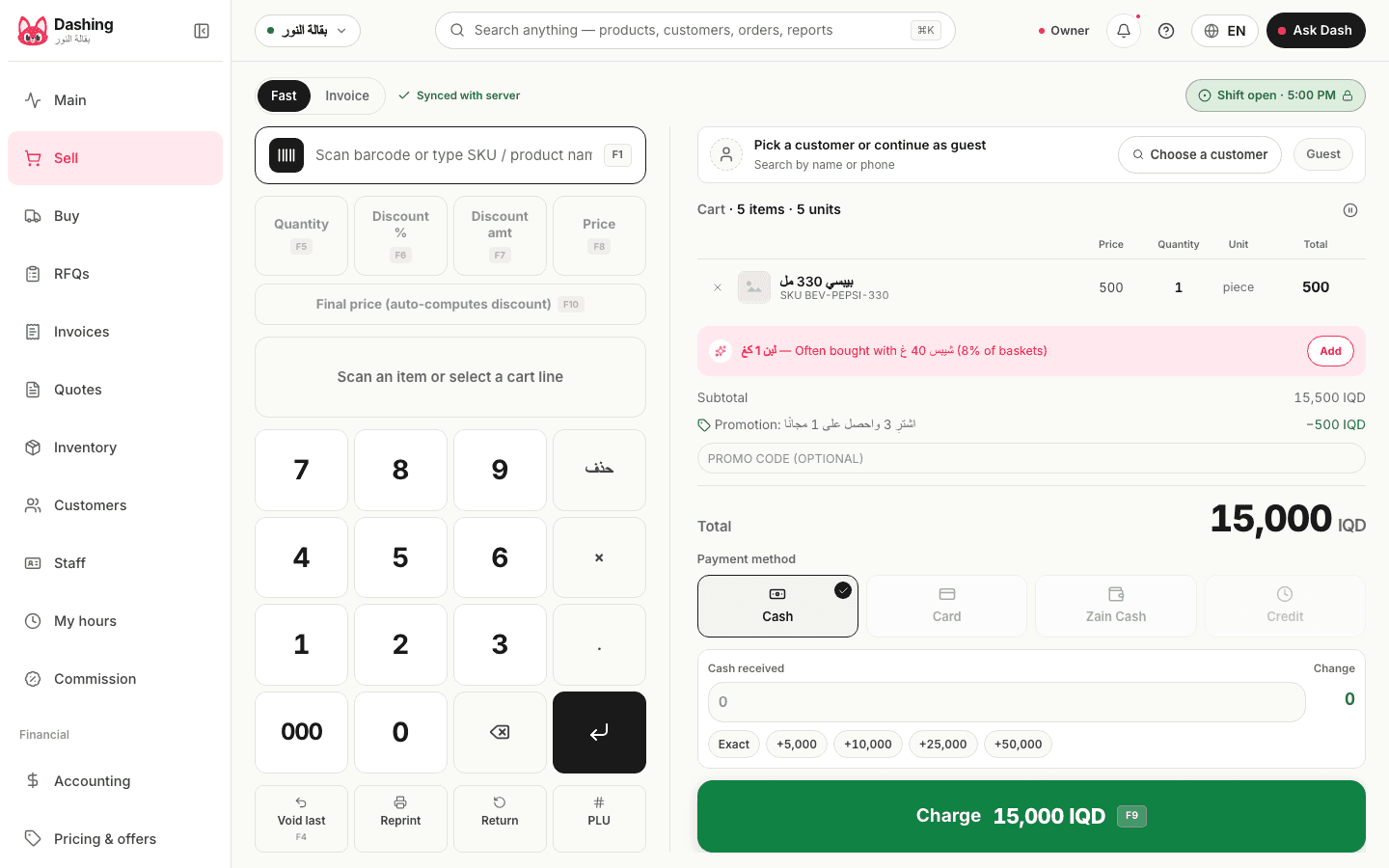
One evening at the counter
F1 puts the cursor back in the scan box. A case of 12 bottles of water scans with its own barcode and deducts 12; the single bottle scans with its own and deducts 1; stock is kept in the base unit. A kilo and a quarter of tomatoes is typed as 1.25 at the price per kilo, because no scale is connected. A customer buying on credit is picked with F2 and the invoice posts to their account. Payment is cash with the change worked out, or card recorded as its own payment method, and the receipt is 80 mm paper from the print dialog or a WhatsApp link valid for a year.
What expires and what runs out
- Every delivery is recorded as a batch with its expiry date; the till suggests the nearest expiry, and an expired batch is flagged and can only be sold with an explicit confirmation, recorded under the name of whoever gave it
- A home-screen card for what expires within 30 days; the window can be changed in Settings
- A minimum per item: the low-stock list, a home-screen card, and a draft purchase order from the suggestion in one tap
- A supplier delivery received in parts; the payable is booked for what arrived each time
- Items import from a CSV file with Arabic or English headers; 500 items with their stock take about 6 seconds
Closing the day
A shift opens with a float and closes with a count; the difference between the counted and expected amounts is booked automatically, and the shift report shows sales and returns by payment method and compares revenue, invoice count and average ticket with the same weekday a week earlier. The shift cannot close until every sale saved on the device has uploaded.
What it does not do
No scale integration: the weight is typed, and a barcode that encodes a weight is not read. No customer-facing display and no 58 mm paper.
Common questions
Can it keep up with the evening rush?
Each scan adds the line to the cart instantly, the total is large enough to read from the other side of the counter, payment is one tap, and the F1 to F10 shortcuts cover the most common actions.
How do I sell the piece and the carton of the same item?
Define the units and the conversion factor once and give each unit its barcode and price; stock is deducted in the base unit.
Does it read a scale barcode that carries the weight?
No. The weight is typed at the till, with fractions; no scale is connected and no weight is read from a barcode.
From the blog
- Barcodes for a shop: EAN-13, in-store numbers and carton barcodesWhat a shop owner in Iraq needs to know about barcodes: what the EAN-13 digits mean, why the prefix is not the country of origin, in-store numbers, and carton vs piece.
- Customer debts: collecting them over WhatsApp without awkwardnessRunning credit sales in a shop in Iraq: a credit limit per customer, debt aging, a statement that reaches the customer on WhatsApp, and the overdue card every morning.
Related
Try it in your shop, free, no card.
The free plan: the whole shop for one branch, an offline cashier with stock, debts and accounting, and no cap on selling. What it includes