Double-entry accounting for shops: every sale posts its own entry, and your accountant finds complete books.
Dashing posts every sale, purchase and expense as a balanced double entry the moment it happens, and the database refuses to save an unbalanced one. Amounts are whole dinars with no fractions, and the home currency is chosen at sign-up: dinar or dollar. The owner sees cash, what customers owe and expenses in plain sentences; the accountant finds the journal, the trial balance and the financial statements in the Accounting section, built on the same data.
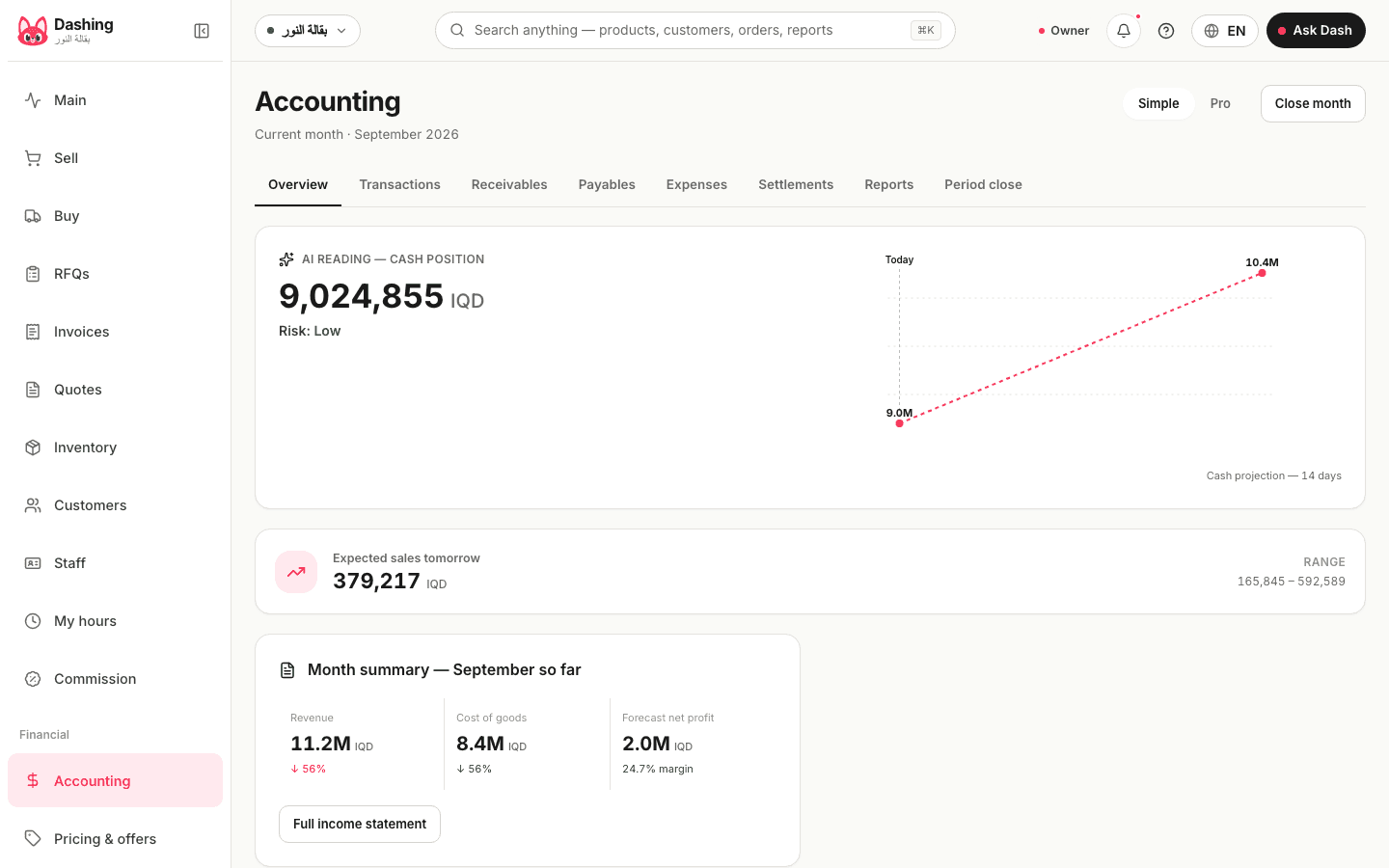
Watch it work
A month at the sample shop
At the sample shop, Al-Noor Grocery, revenue for the first half of September came to 8,657,000 dinars, net profit to 1,464,610, gross margin to 25.2%, cash in the two drawers and the bank to 8,598,810, and 1,324,080 was owed to suppliers. Nobody wrote a single entry by hand: 934 invoices posted their entries the moment they were sold, received purchase orders posted the suppliers' entries, and expenses were recorded from a phone with a photo of the receipt.
What is posted automatically
- Sales, returns, purchases, receipts and payments, each as a balanced entry; a return reverses exactly what the original sale posted rather than a freshly computed total
- Expenses from the phone with a photo of the receipt, petty cash and recurring expenses
- Recurring entries such as rent and salaries on a schedule; the amount can be a formula, and an approval can be required before posting
- Sales tax when you switch it on: tax codes and rates per line, and a tax return computed from the books
The reports, by name
Income statement, Balance sheet, Trial balance, Cash flow statement, General ledger, Sales report, Expense report, Inventory report, Customer report, Receivables aging, Payables aging, and the VAT / tax return when tax is switched on. A statement per customer and per supplier. The financial reports need an internet connection; the cashier does not.
Dinars and dollars
The books are in one currency chosen at sign-up and never changed: Iraqi dinars for most shops, or dollars for a business that works in them. In dinars there are no fractions: 250 is the smallest note, and amounts are whole. With multi-currency switched on in Settings, quotes are priced in the other currency at a rate you type, and become invoices in your home currency at that rate; if the customer settles later at a different rate, the difference is booked. No exchange rate is fetched automatically, and a rate older than 7 days is flagged as stale.
When the accountant comes
You give your accountant their own account, limited to the accounting and reports screens; they work from their office in any browser and never see the cashier. They export the journal to Excel, the statements to PDF, and the invoice, customer and item lists to CSV. They post adjusting entries by hand, whether accruals or corrections, with a written reason that stays with the entry, and correct a wrong entry with a reversal dated today. After the review they lock the month so no back-dated entry is accepted, and close the fiscal year with a proper closing entry; each of these actions requires the permission. What they will not find: a link to a tax authority, automatic bank feeds, or a fixed-asset screen; depreciation runs on the server without a screen yet, and bank reconciliation is done by manual matching.
Ask Dash about the report
Ask "why did the margin drop this month?" and Dash answers from the report's own numbers, through tools that read your books directly and never invent a figure. It needs an internet connection and is capped at 10 messages an hour on the free plan.
What it does not do
No e-invoicing and no tax-authority link (none exists in Iraq today), no automatic bank feeds (Iraqi banks offer no interface for them), no fixed-asset screen, and no multi-company under one account. The financial reports need internet.
Common questions
Do I need an accountant to use it?
No. The money screen is written for the owner, with no jargon. When your accountant comes, the balanced books are complete in the Accounting section: the journal, the trial balance and the statements.
Does it work in dinars and dollars?
The books are in one currency chosen at sign-up: whole dinars for most shops, or dollars for a business that works in them. Quotes can be priced in the other currency at a rate you type and become invoices in your home currency; the cashier is in your home currency.
Can my accountant work from their office?
Yes, with their own account and permissions limited to the accounting and reports screens, from any browser, with everything they do in the audit log.
Can an entry or an invoice be deleted?
Nothing is deleted. An invoice is voided with a visible reversing entry, and the original and the void stay together in the audit log under the name of whoever did it. After a period is closed, no entry dated inside it is accepted.
From the blog
- An accounts program for a shop: what you need, and what is sold to youWhat an accounts program must do for a shop in Iraq: real profit, debts by name and age, the drawer, books the accountant can open. And what is sold to you, unneeded.
- Accepting Zain Cash, Qi Card and FIB at the counter: fees and bookingAccepting e-payments in an Iraqi shop: the merchant fees Zain Cash publishes, what Qi Card, FIB, SuperQi and AsiaHawala do not, and how each payment is booked in Dashing.
- The 8 best accounting systems for shops in Iraq (2026)Eight accounting systems shops in Iraq use: Dashing, RA8M, Al-Ameen, Daftra, Wafeq, Zoho Books, QuickBooks, Odoo, with vendor-page prices and who each one fits.
- The 8 best cashier systems in Iraq (2026): an honest comparisonEight POS systems used in Iraq: Almas, RA8M, Kashir, Dashing, Al-Ameen, Daftra, Odoo, Loyverse, with vendor-page prices, who each fits, and what each lacks.
Related
Try it in your shop, free, no card.
The free plan: the whole shop for one branch, an offline cashier with stock, debts and accounting, and no cap on selling. What it includes