How to choose cashier software for a shop in Iraq (2026 guide)
Ten questions to ask before buying a cashier system in Iraq: offline, Arabic and Kurdish, whole dinars, real accounting, debts on WhatsApp, branches, export, price.
The Dashing team6 min read
Most shops in Iraq buy their first cashier system the same way: a technician installs something on a PC, shows the owner the sell screen, and leaves. Six months later the stock count is wrong, the customer debts live in a notebook again, and nobody knows the real profit. The software was not the problem; the questions asked before buying were.
Here are the ten questions that matter, with the honest answer for Dashing (داشنك) where it is relevant, including where it is not the right choice.
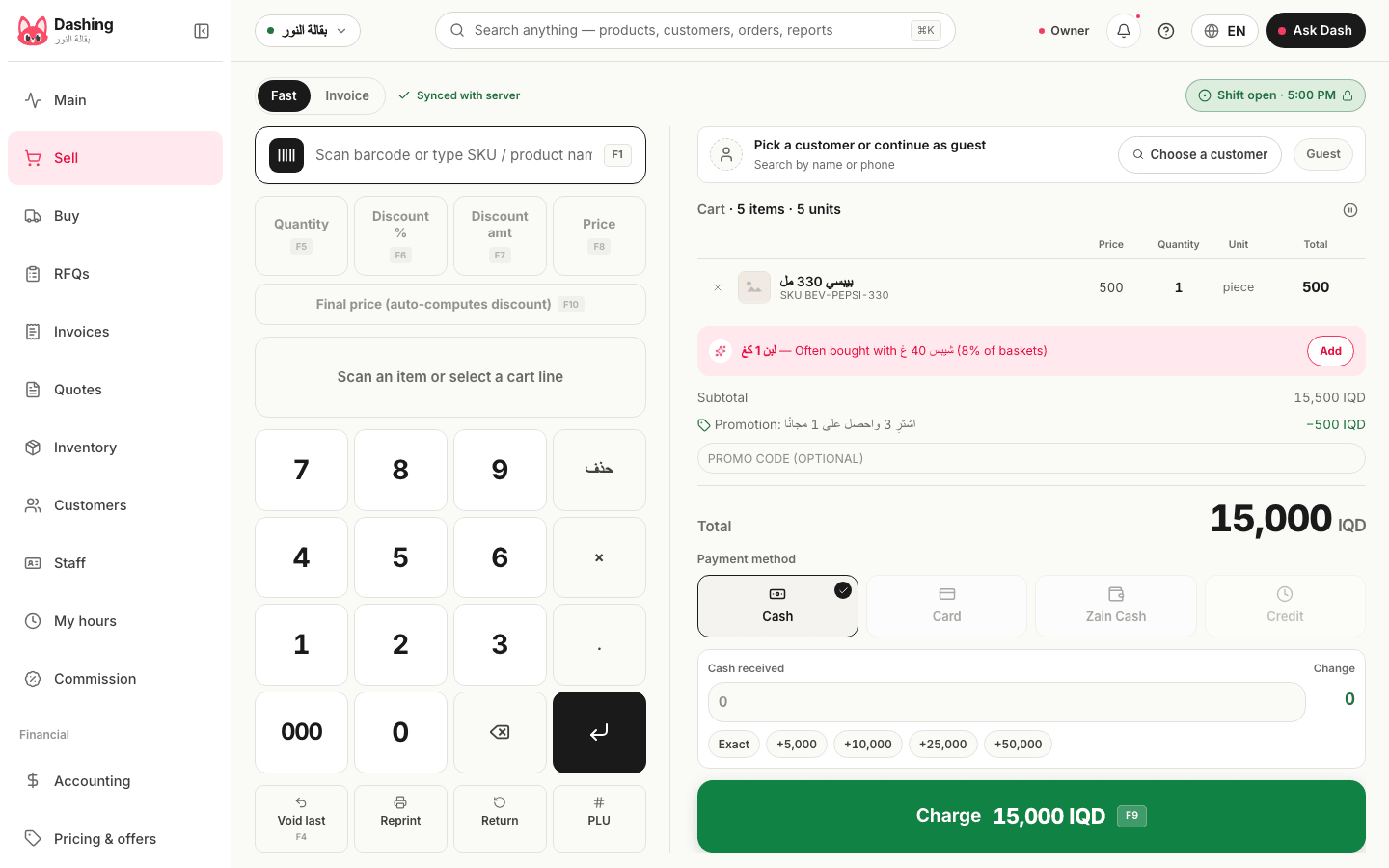
1. What happens when the internet drops?
Do not ask "does it have an offline mode"; ask what exactly keeps working, and what happens to the sales made offline when the connection returns. Iraq had more than 80 internet shutdowns in two years, most of them ordered during school exams, plus the everyday cuts every shop knows.
Three kinds of answer exist:
- Cloud-only: the sell screen stops. Some vendors say "rarely happens". It happens on exam mornings, at 6 am, on schedule.
- Local server: works without internet, but the data lives on one PC in the shop. A dead hard drive is a dead business record.
- Offline-first: sales are saved on the device and uploaded automatically when the connection returns, once, never twice.
Dashing is the third kind; how the offline cashier actually works explains the mechanics and the limits.
2. Is Arabic the first language, or a translation?
Open the sell screen and the reports. If the buttons read like a translated manual, the accountant will end up working in English and the cashier will guess. Ask also for Kurdish (Sorani) if any of your staff or customers speak it, in Erbil, Sulaymaniyah and Duhok this is not optional. Dashing is designed in Arabic first, right-to-left, and written in Kurdish and English at the same level; every user picks their own language.
3. Does it understand the dinar?
Two details give away software built for another market:
- Decimals. The dinar has no working fractions; a system that shows
2,500.00and computes tax to three decimals was built for somewhere else. Dashing keeps the books in whole dinars. - Dollars. Many shops quote in dollars and take dinars. You want to price a quote in dollars at your rate when a customer asks for it, while the invoice and the books stay in dinars. In Dashing, quotes are priced in dollars at the day's rate you enter and become invoices in your home currency, the dinar for almost every shop.
4. Does it work with the hardware you already own?
You should not need a special terminal. Any laptop, Android tablet or phone with a browser; any keyboard-wedge barcode scanner; any 80 mm thermal printer that your operating system can print to. Ask whether the receipt can also be sent as a WhatsApp link; in Iraq that matters more than the paper.
5. Is there real accounting underneath, or just a sales list?
A "cashier program" that only records sales cannot tell you your profit: cost of goods, expenses, customer debts and supplier debts are missing. Ask for the income statement and the balance sheet, and ask how they are produced. If the answer is "export to Excel and give it to the accountant", the system is a sales list.
Dashing books every sale, purchase, expense and payment as a double-entry journal entry in the background. The owner sees an overview in plain language; the accountant opens the full books (journal, trial balance, statements) in the same Accounting section. Accounting has the detail.
6. How does it handle customer debts?
Credit sales are how shops in Iraq work. The questions: is there a credit limit per customer, does the system age the debts (30, 60, 90 days), and can you send the customer a statement without printing it? Dashing sends a statement as a WhatsApp link that stays valid for 30 days, and shows the customers more than 30 days late on a card every morning.
7. Branches: now or later?
Even if you have one shop today, ask what a second branch costs and whether stock, drawers and profit are tracked per branch. Many systems charge per "location" and mix the stock into one pool. In Dashing every branch has its own stock, drawers, shifts and profit, and the system suggests transfers when one branch runs short.
8. Who can do what: and can you see who did it?
A cashier should not be able to change prices or see the profit. Ask for per-screen permissions and for an audit log that cannot be edited: every price change, discount, void and drawer count, with a name and a time. This is also what your accountant will ask for.
9. How do you leave?
Your data is yours. Ask, before you pay, whether you can export everything to CSV at any time, and what happens to the data after you stop paying. Dashing exports any list at any time and keeps your data available for 90 days after a subscription ends.
10. What is the real price?
Add up: the plan, per-user fees, per-branch fees, per-transaction fees, "setup", training, and whether the price is in dollars (and therefore moves with the rate). Ask whether it renews automatically and whether there is a refund window. What cashier software costs in Iraq compares the numbers.
Dashing's pricing is one line: the whole shop free for one branch, and one yearly plan at 420,000 IQD that adds branches and Dash at 100 messages an hour, with no per-transaction fees, a 14-day money-back guarantee and no auto-renewal.
When Dashing is not the right choice
- Restaurants with table service or a kitchen screen. Dashing has no tables, no modifiers, no KDS. Cafés and quick-service counters work; a sit-down restaurant does not.
- A company that needs e-invoicing with a tax authority (Saudi Arabia, Egypt, Jordan…). Iraq has none today, and Dashing does not implement one.
- A business that wants books in two currencies at once. The books are in one home currency chosen at sign-up (the dinar for almost every shop, or the dollar), and it cannot change afterwards.
A one-page checklist
| Question | Bad sign | Good sign |
|---|---|---|
| Internet drops | "Rarely happens" | Sales saved on the device, uploaded once |
| Language | Translated menus | Arabic-first, Kurdish available, per user |
| Dinar | Three decimals | Whole dinars, quotes in USD at your rate |
| Hardware | Special terminal | Any browser device, any scanner and printer |
| Accounting | "Export to Excel" | Income statement and balance sheet from the same data |
| Debts | A number per customer | Credit limits, aging, statement by WhatsApp |
| Branches | One stock pool | Stock, drawers and profit per branch |
| Permissions | Everyone sees everything | Per screen, with an audit log |
| Leaving | "Contact support" | CSV export any time |
| Price | "Depends" | One number, no per-transaction fees, refund window |
Sources
- Internet Society Pulse, Iraq to Shutdown Internet During 2025 Exam Period (May 2025), https://pulse.internetsociety.org/en/blog/2025/05/iraq-to-shutdown-internet-during-2025-exam-period/
- Dashing pricing and plan limits, https://dashing.krd/en/pricing (checked 2026-09-14)
This article is also available in العربية · کوردی